
An underwater handshake
Field note - Mexican Pacific - Banderas Bay
Meeting a patient and curious Giant manta ray
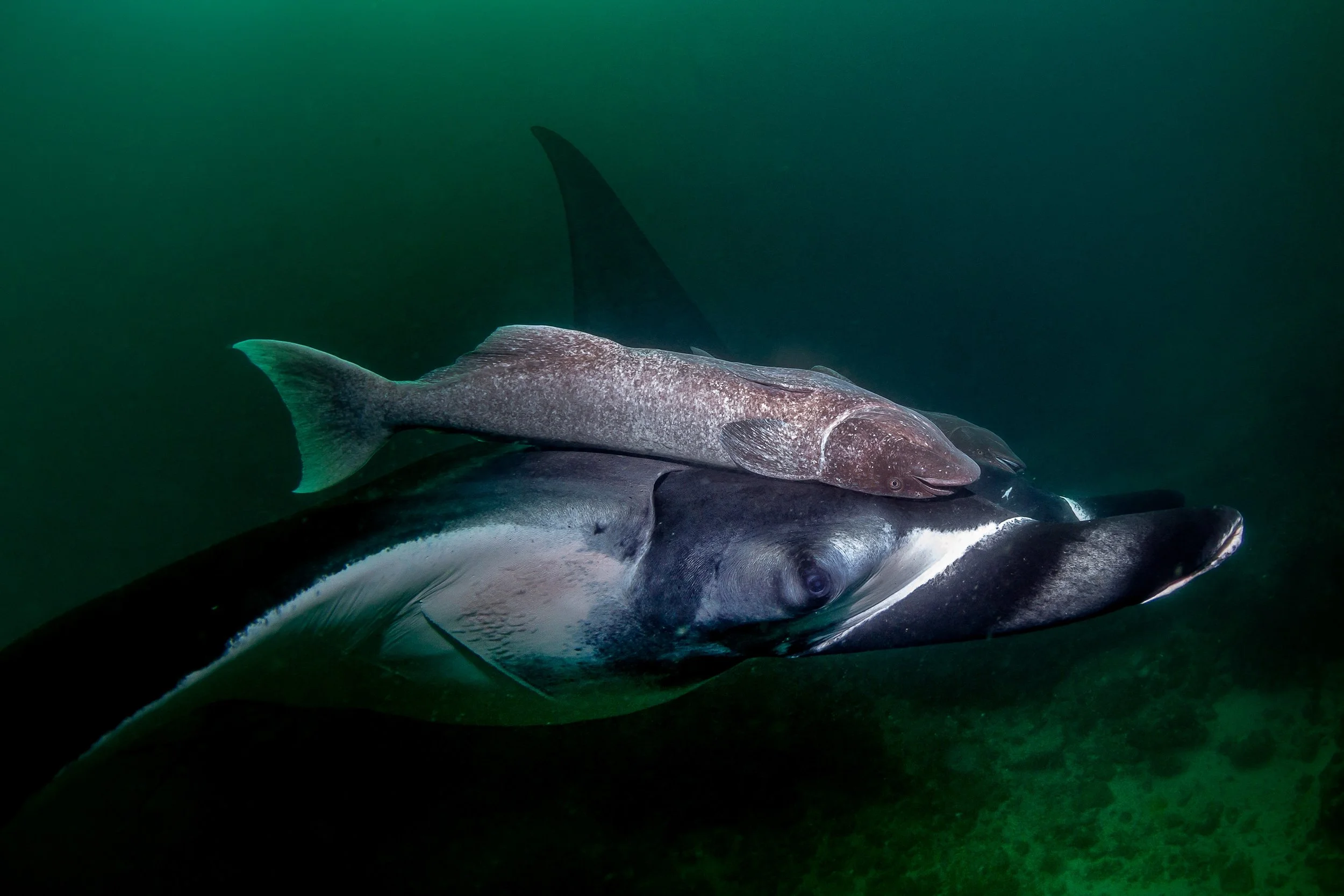
As I glide over the top of the Devil's Jaw, I don't know that I am being watched. Visibility is terrible today, and I have to swim close to the seafloor to find something to photograph. But I'm snapped out of my reverie when I hear Cesar shout into his regulator. As always, he is slightly ahead of me, and I lift my eyes to find him. But instead of the familiar figure of a diver with split fins, I'm staring into a giant black carpet. Manta — and a big one! I have one and a half ton of fish five feet away from me. If it hadn't been for Cesar, I might never have known.
I stare. The manta floats past me slowly, and as I turn to follow, I see how it dips gently and folds its huge pectoral fin to carve a slow right turn. As it travels, its form fading into the greenish hues of cold, murky water, I lean sideways to intercept it on what I judge will be its future course. I know better than to try chasing it.
A second or two later, I cannot see it anymore. I wait. The abyss of the Jaw with its 1400 deep, cold feet looms black below me. I wait some more. Just as I start thinking I was wrong and the manta is gone for good, I see it again. It is moving slowly but steadily toward me. It keeps coming. Another stroke of its fins brings it within touching distance. It passes at my level, and I can see its large eye lock into mine. We are looking at each other for a second, two, three. The manta holds a steady speed, and I need to start kicking to keep up.
It carries two very large remoras on its head. The one closer to me shudders and moves off, slightly unnerved by my proximity. Meanwhile, the manta, completely untroubled, holds my stare. Eventually, I stop kicking, and the manta slowly drifts off, following the same arching path as before.
I see Cesar, some 20 feet away, patiently waiting his turn. He doesn't have to wait long. The manta moves past him a moment later, dips its fin, and glides away. I cannot see it anymore, but I feel this encounter isn't over yet. I wait. Hanging above the blackness, the rocky shelf on my left, I contemplate the green wall of cloudy water and wait.
Then the manta comes again. What happens next is a carbon copy of its last pass. A few seconds within arm's reach from me, looking into my masked face, remoras freaking out. Then past Cesar and gone into the void. This is amazing. There is absolutely no doubt in my mind that the manta chooses to come back to us. I am not sure what to call it. Interest? Curiosity? Both terms sound somehow lame to me.
Then Cesar signals to me with his hands. He will lead the rest of our dive group back to the surface. I check my gauges. I have plenty of air, but this being our second dive, my non-deco will also start chasing me up in a few minutes. I am not ready to leave yet, though. I move away from the vertical wall below me and aim for the main mass of the islet. I look up and see my buddies disappear from sight. I cannot see the manta anymore. I swim on.
Another minute passes and I reach the islet's main wall. I am at 30 feet of depth now, and my non-deco jumps to a comfortable 40 minutes. I have 1000 psi in my tank. I am good. As I look for another photo opportunity, a movement over my left shoulder catches my eye. I turn. The manta is back.
This is astonishing. How on earth did it even find me in this mess? The visibility is a lousy 15 feet here. Just as before, the manta approaches in a swooping arc. In a few seconds, it is so close I could practically kiss it. I didn't see much point in taking a photo before, water conditions being what they are. Now I raise my camera. The side of its face, topped by its starboard remora, fills my wide angle. I snap a portrait of my new companion, slightly afraid to spook it with my flash. The event doesn't seem to bother it, though, and it continues on its circular cruise. This is truly wonderful.
Before I run out of air 20 minutes later, the manta comes back repeatedly to within an arm's length of me. Even as I ascend to my safety stop, I can see its dim shadow circling below. "Is it looking for me?" I have to ask myself. I don't know, of course. But it sure feels like it. I am often sorry when the limits of scuba command me to return to the surface; now, I feel almost sad.
I wish I could stay longer and try to figure out what drives this magnificent animal to seek our company. Thanks to scientific research, we know mantas are smart, large-brained, possessing problem-solving capacity, and possibly even self-aware. But it is one thing to read a paper and quite another to play a part in an underwater interspecies handshake.
It is unforgettable.